Replacement builds in the City of Zurich: many demolitions, but more homes overall
City of Zurich Statistics (Statistik Stadt Zürich) has published the construction figures for the third quarter of 2026. In the City of Zurich, 1'262 homes were completed and 639 were demolished. That is more demolitions than in any quarter since 2009, the first year in the city's figures. The number of completions was the second-highest ever recorded for a quarter. The housing stock grew by 606 to 238'961 homes. That increase isn't simply completions minus demolitions: conversions of existing buildings and other changes count too.
Here is 2026 so far:
- First quarter: 681 homes completed, 610 demolished, housing stock down 2
- Second quarter: 200 completed, 327 demolished, housing stock down 115
- Third quarter: 1'262 completed, 639 demolished, housing stock up 606
Together that's 2'143 homes completed and 1'576 demolished, more demolitions than in all of 2025 (1'379). And according to the city, 2025 was itself the year with the second-highest number of demolitions: only 2021 had more. Even so, at the end of September the city had 489 more homes than at the end of 2025. It was the first time this year that the housing stock was above that level.
Many of these demolitions make way for replacement builds (Ersatzneubauten), meaning new buildings on the site of demolished ones. In its three quarterly reports, the city names six projects and gives the number of old homes and the number planned for each. Here they are by neighborhood:
- Hirzenbach: 183 demolished, 384 new homes
- Hard, Stüdli housing development: around 140 being replaced by 151 new ones
- Schwamendingen, Roswiesenstrasse: 110 demolished, more than 200 new ones by 2030
- Seebach, Gartenstadt Köschenrüti: 50 demolished so far and around 250 across all phases, 300 new ones by 2030
- Altstetten, Letzigarten: more than 130 demolished, 376 new rental apartments
- Altstetten, Salzweg housing development: 130 demolished, around 300 new ones
Added up, these six projects replace around 940 homes with a little over 1'700. Those totals are my own, calculated from the city's figures. They cover only these six projects, not all demolitions. The gain isn't spread evenly. Four projects roughly double the number of homes, or more, while the Stüdli development adds around 10 and Köschenrüti around 50. Writing about the 2025 figures in February, the city said that, as a rule, demolitions are followed by (translated) "replacement builds with more homes". It took the high number of demolitions as a sign that a lot will be built in the coming years too.
Two caveats go with that calculation. First, a long time passes between demolition and replacement. The homes on Roswiesenstrasse were demolished in the second quarter, and they are due to be replaced by 2030. Until then, those homes are gone, and the people who lived in them have had to move out. Second, individual projects drive the quarterly figures. Of the 1'262 completions, around 220 are in the Riedtower in the Leutschenbach neighborhood and 133 in the Herzogenmühle new-build project in Schwamendingen. In the second quarter, by contrast, no major new-build project was completed. At the bottom of every report, the city notes that quarterly results are (translated) "subject to random fluctuations".
Across the whole canton, the picture is weaker. According to the canton's Office for Statistics and Data (Amt für Statistik und Daten), around 7'800 homes were completed in new buildings in 2025 and almost 2'600 were demolished. The net gain in homes (Wohnbausaldo), meaning new builds minus demolitions, was around 5'200. That is one of the lowest figures of the last fifteen years. The office gives two reasons why the net gain has been low for years: not much is being built, and a lot is being torn down for replacement builds. In the early 2010s, around 1'500 homes a year were demolished on average. Now the figure is regularly around 2'500. The net gain is above the multi-year average in the City of Zurich and along Lake Zurich. In rural areas and the suburbs (Agglomeration), it has fallen to record lows in the last two years. In Winterthur, more homes were demolished than built in 2025. In Schlieren, 106 more homes were demolished than built.
Sources (in German): City of Zurich Statistics, construction activity and housing stock, third quarter of 2026, October 2026 · second quarter of 2026 · first quarter of 2026 · City of Zurich, press release on housing construction in 2025, February 2026 · Canton Zurich, Office for Statistics and Data, housing construction in 2025, 25.02.2026
Home prices: still rising, but a little more slowly
On 7 October 2026, the real estate consultancy IAZI published its price indexes for the third quarter. Owner-occupied homes, meaning condominiums and single-family houses together, cost 0.8 percent more in Switzerland than in the previous quarter and 3.3 percent more than a year earlier. Condominium prices rose by 3.9 percent over twelve months and single-family house prices by 2.8 percent. According to IAZI, the index is based on (translated) "actual open-market transactions" (Freihand-Transaktionen), meaning completed sales. It measures prices paid, not asking prices in listings. The figures are as of 30 September 2026.
The second part of IAZI's release says more about the market. IAZI writes (translated): "Compared with the previous quarters, price momentum has weakened slightly overall." IAZI is also seeing slightly fewer home sales, and mortgage volume is growing more slowly. It adds (translated): "The affordability of homeownership remains a challenge." Affordability (Tragbarkeit) is about whether a household can pay the ongoing costs of a home it owns out of its income. According to IAZI, high purchase prices increasingly limit what buyers can finance, and banks remain cautious when a mortgage is only just affordable for the buyer.
Interest rates continue to support demand, IAZI writes. Ten-year fixed-rate mortgages cost around 2 percent. SARON mortgages, whose rate follows the Swiss National Bank's policy rate, cost a little over 1 percent. But IAZI thinks fixed-rate mortgages could get more expensive if long-term rates in the capital markets keep rising. The post of 28 September explains how that can happen without the policy rate moving.
On supply, the release distinguishes between renting and owning. The vacancy rate (Leerwohnungsziffer) is the share of all homes that are vacant and offered for rent or for sale. The lower it is, the tighter the supply. According to the Federal Statistical Office, it has fallen across Switzerland for the sixth year in a row, to 0.93 percent on the reference date of 1 June 2026. IAZI's reading of the vacancy count is that the decline shows up mainly in rental apartments. Of the roughly 45'000 vacant homes, just under 11'000 are homes for sale, about the same as the long-term average.
The canton's Office for Statistics and Data analyzed the same count for Canton Zurich. Here, the vacancy rate rose slightly, from 0.48 to 0.52 percent, against the national trend. More than 75 percent of the vacant homes are rental apartments. Over a longer period, the two segments diverge. Vacancies among rental apartments are almost 30 percent below the average of the last ten years. Among homes for sale, they are 5 percent above it.
The release has three limitations:
- It covers Switzerland as a whole. Neither the release nor its charts give a figure for Canton Zurich.
- It separates single-family houses from condominiums, but not new homes from existing ones. You can't tell from it how prices for new-build apartments are moving.
- It looks back. For the near future, IAZI expects little to change. It ties that to two conditions: no change of course in interest rate policy and no marked worsening of the economic outlook.
Sources (in German): IAZI, real estate price indexes, third quarter of 2026, 07.10.2026 · IAZI, charts for the price indexes, as of 30.09.2026 · Federal Statistical Office, vacancy count, 10.09.2026 · Canton Zurich, Office for Statistics and Data, vacancy count, 18.08.2026
What this means for Canton Zurich
The demolition figures are for the City of Zurich. After three quarters, its housing stock is above the end-of-2025 level despite all the demolitions. Together, the six replacement builds named above will add more homes than they remove. The city gives a date for only two of them, in both cases by 2030. Across the canton, the net gain is smaller, because not much is being built and a lot is being demolished. In Winterthur, more homes were demolished than built in 2025.
The IAZI release gives figures for Switzerland as a whole and no prices for Canton Zurich. What the canton does report is vacancies: at 0.52 percent, the vacancy rate remains low. But vacancies are below the ten-year average only among rental apartments. Among homes for sale, they are slightly above it.
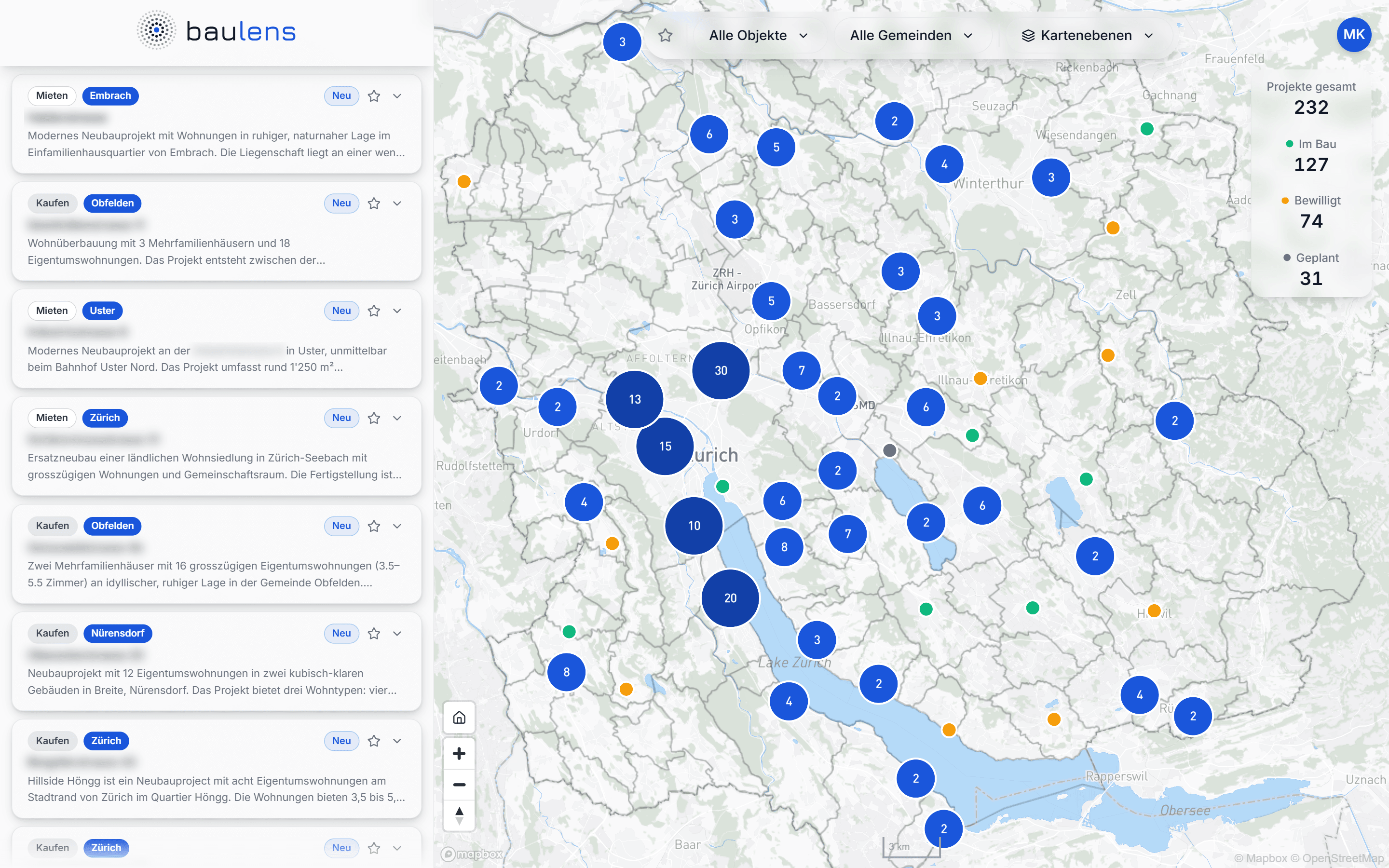
The Baulens map shows which new-build projects in the City of Zurich and across the canton are planned, approved or under construction. It only shows projects with their own project website. It doesn't show demolitions or prices: where prices are available, they're on the project's own website, and every project links straight to it.