Rents in the City of Zurich: the citywide median doesn't fit a new build
On 29 September 2026, City of Zurich Statistics (Statistik Stadt Zürich) published its 2026 rent survey (Mietpreiserhebung). Rents per square meter have risen by 3.1 percent since 2024, while the Zurich consumer price index rose by 1.2 percent over the same period. Between 2022 and 2024, rents had risen by 6.5 percent. Even so, the office sees no turnaround in rents.
To read the numbers, it helps to know what the survey measures. It estimates rents under existing leases from a sample, not the prices in listings. It also covers only apartments with two to four rooms (in the Swiss count, which includes the living room). That is a little over 80 percent of the rental apartments in the city. All figures are net rents (Nettomiete), meaning without ancillary costs (Nebenkosten), as of the reference date of 1 April 2026. The survey's headline figure, the mittlerer Mietpreis, is the median rent: half of the rents are above it, half below.
The survey uses a typical rental apartment of 75 square meters as its yardstick and estimates its rent at around 1'690 francs a month. All franc amounts below are for an apartment of that size.
Who owns the building makes a big difference. When the owner is a non-profit (gemeinnützig), such as a housing cooperative, the typical apartment costs about 1'150 francs. When it's anyone else, which I'll call a for-profit owner here, it costs 1'990 francs.
For a new-build apartment, a different number says more: 2'907 francs. That's what the typical apartment costs in a for-profit new build. The survey counts an apartment as a new build if the building is newly constructed and the tenants moved in within the last two years. That usually makes it the apartment's first lease. Under a new lease in an older for-profit building, the typical apartment costs 2'287 francs, 620 francs less. If the lease in such a building has been running for three to ten years, the figure is 2'086 francs. After more than twenty years, it's 1'416 francs. The city puts it this way (translated): "The longer a tenancy has existed, the lower the rent."
City of Zurich Statistics attributes the higher new-build rents partly to construction costs. Residential construction prices, meaning the cost of building itself, have risen by around 17 percent over the last six years. General inflation in the city was around 7 percent over the same period. Rents per square meter in for-profit new builds have risen by an estimated 11 percent since 2024. According to the survey, that is more than for leases that have been running for at least three years.
Three things I take from this:
- The citywide median is the wrong yardstick for a new build. The 1'690-franc figure lumps all surveyed leases together, non-profit and for-profit, including leases that have been running for more than twenty years. Across all for-profit apartments the median is 1'990 francs, and in a for-profit new build it's 2'907 francs.
- The figures are only comparable net and per square meter. The published figures are net rents: 22.5 francs per square meter per month across all apartments, 38.8 francs in a for-profit new build. According to City of Zurich Statistics, gross rents (Bruttomiete) are 10 to 15 percent higher, depending on which figures are compared. So to compare a listing with these numbers, you need its net rent divided by its floor area.
- The survey doesn't show the market you're searching in today. City of Zurich Statistics says so itself (translated): "Anyone currently looking for an apartment in Zurich is likely to find the rents shown here low." According to the city, asking rents for advertised apartments are usually considerably higher.
The 3.1 percent increase doesn't contradict the recent 3.3 percent drop in asking rents in the canton (post of 25 September). The 3.3 percent is for newly advertised apartments across the whole canton, over one year.
Sources (in German): City of Zurich, press release on the 2026 rent survey, 29.09.2026 · City of Zurich Statistics, "Mietpreise steigen in der Stadt Zürich um rund drei Prozent", 29.09.2026 · City of Zurich Statistics, method report on the 2026 rent survey
Heritage protection: what changes for building projects on 1 November
On 18 September 2026, the Federal Council amended two ordinances: the Spatial Planning Ordinance and the ordinance on ISOS, the Federal Inventory of Swiss Heritage Sites. ISOS is the federal list of protected townscapes. The new provisions take effect on 1 November 2026. Until then, the current rules apply. According to the press release, the aim is (translated) "to simplify and speed up planning and permit procedures without disproportionately restricting townscape protection".
I'm covering the decision for two reasons. It takes effect in just under four weeks, and in the City of Zurich it affects more residential buildings than the term townscape protection (Ortsbildschutz) suggests.
ISOS has applied to the City of Zurich since 2016, and around 75 percent of the city's settlement area (Siedlungsgebiet) is subject to ISOS protection goals. The obstacle was not the inventory itself but its direct application (Direktanwendung). According to the city, the inventory applies directly (translated) "when a plan or a building project lies within an ISOS perimeter and the fulfillment of a federal task is affected at the same time".
Even an ordinary residential building can involve a federal task (Bundesaufgabe). According to the City of Zurich, work that reaches into the groundwater is one of the most common cases. If an underground garage in a water protection area (Gewässerschutzbereich) reaches below the average groundwater level, it needs an exemption permit from the canton under water protection law. Under the case law of the Federal Supreme Court, that permit counts as a federal task. Until now, that has made the federal inventory apply directly to the whole project. The project then has to be assessed for its effect on the townscape, with an expert opinion from a federal commission if there is any doubt. That's true even if the garage is underground and doesn't change the townscape at all.
The Federal Office of Culture describes the consequence. Many residential projects are held not to have the interest of national importance that is required in these cases. That leads (translated) "to the suspension or abandonment of many projects that are already far advanced in planning".
From 1 November, a new rule applies within building zones (Bauzonen). If the federal task rests solely on a permit under federal law, and the part of the project that needs the permit has no effect on the townscape, the work is allowed as far as townscape protection is concerned. It no longer needs an expert opinion from a federal commission. Back to the example: if the underground garage in the groundwater doesn't change the townscape, the garage alone no longer makes the federal inventory apply directly.
The building permit authority, usually the municipality, decides whether the condition is met. The groundwater permit itself is still required. The Federal Office of Culture expects the new provision to apply in most cases where a structure lies below the groundwater level.
The City of Zurich expects that the inventory will then apply directly (translated) "only in very rare cases", and that thousands of blocked apartments can then be built soon. It gives no exact number on its page. According to the news agency SDA, the 4'000 apartments from the headlines go back to a report by SRF's regional radio program Regionaljournal Zürich-Schaffhausen.
Three caveats:
- The inventory stays. What changes is mainly when it is applied directly.
- The ordinance is silent on pending building applications. The Swiss association of cities (Schweizerischer Städteverband) pushed for the change. In the consultation on the draft (Vernehmlassung), it pointed out that it remains unclear whether the new rule also applies to permit procedures that are already pending. The ordinance only gives the date it takes effect.
- The right of appeal under cantonal law stays. Canton Zurich has no objection procedure (Einsprache) against a building application. Anyone who wants to contest a project has 20 days from the public notice to ask for the decision on the building application to be sent to them. Once it arrives, they have 30 days to file an appeal (Rekurs). What may drop out is one ground for appeal: the direct application of the federal inventory, in cases where the new provision applies.
So I don't expect all blocked projects to move ahead at once on 1 November. According to SDA, building applications in Zurich can be submitted under the new rules from that day. The federal government wants to review the effect: the Federal Department of Home Affairs will report to the Federal Council by the end of 2028.
Sources (in German): Federal Council, press release on the application of ISOS, 18.09.2026 · Federal Council, amendment of the ISOS ordinance and the Spatial Planning Ordinance, 18.09.2026 · Federal Office of Culture, explanatory report on the amendment, 01.09.2026 · Federal Office of Culture, report on the results of the consultation, 01.09.2026 · City of Zurich, ISOS direct application, September 2026 · Planning and Building Act of Canton Zurich, §§ 315 and 316 · Canton Zurich, building application and permitting process · SDA, via Baublatt, 24.09.2026
What this means for Canton Zurich
The rent survey only covers the City of Zurich. For a new-build apartment, the number that matters is the one for new builds, not the median across all apartments.
The ISOS change is federal law and also applies to the protected townscapes in other Zurich municipalities. For anyone looking for an apartment, 1 November changes nothing for now: a project that's blocked today first has to be approved and then built.
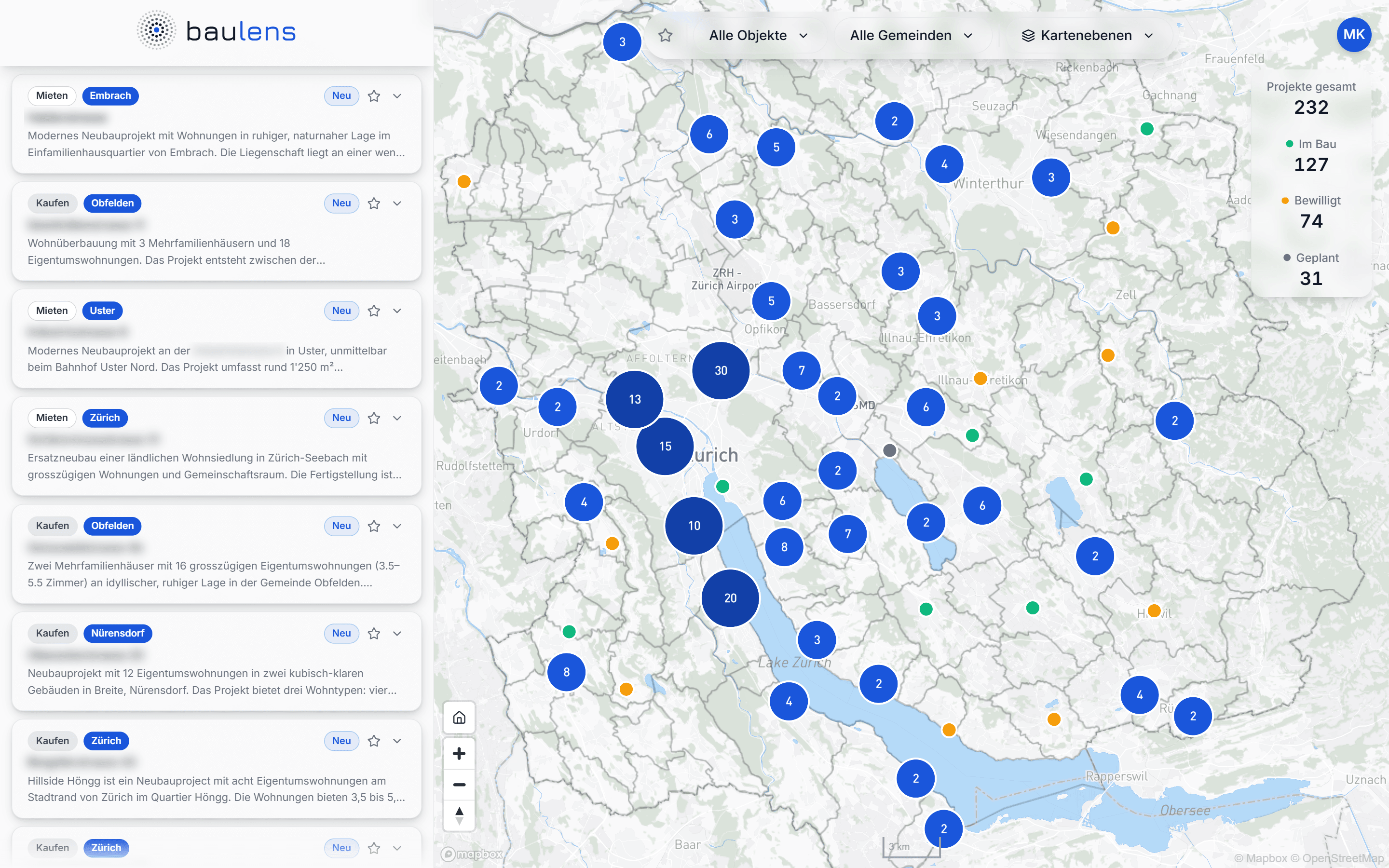
The Baulens map shows which new-build projects in the City of Zurich and across the canton are planned, approved or under construction. It only shows projects with their own project website, so a project that's still in the permitting process usually won't be there yet.