More housing construction, still low vacancy
Wüest Partner expects housing construction to pick up. According to the Federal Statistical Office, Switzerland gained a net 40'000 homes in 2024. For 2025, Wüest Partner estimates 39'000, the lowest figure since 2009. For 2026, the study expects around 45'000 additional homes, and around 50'000 for 2027.
The reason lies a few years back. From 2020, vacancy fell quickly and the value of residential property rose considerably. That made new projects attractive. Many of the projects developed since then have now cleared planning and approval and are close to completion. So the housing market reacts in years, not months.
The upturn is unevenly spread, though. In 2026, growth is above the long-term average mainly in a few cantons in western Switzerland and the Alps. In 2027 it's expected to broaden, especially in Thurgau, Geneva, Valais and Neuchâtel. According to the study, the situation in the major urban centers is likely to remain tight, and around half of the cantons are still building less than their long-term average. The building applications registered today point to no further acceleration for 2028.
The vacancy count shows how tight the market is. On the reference date of 1 June 2026, 45'493 homes stood empty in Switzerland, 0.93 percent of the housing stock. The vacancy rate (Leerwohnungsziffer) has now fallen for the sixth year in a row and is below 1 percent for the first time since 2013; 15 cantons are below that mark. It measures the share of empty homes: a low value points to a market with strong demand.
Zurich is the exception. The Zurich region, which corresponds to the canton, was the only one to record a slight increase, from 0.48 to 0.52 percent, or from around 3'800 to 4'200 empty homes. The highest values are in the Oberland (0.95 percent) and Pfannenstiel (0.90 percent) regions. In the City of Zurich, 252 homes stood empty, 0.11 percent of the stock.
Rents are moving too. Between July 2025 and July 2026, asking rents in Canton Zurich fell by 3.3 percent, after rising by 2.1 percent the year before. Across Switzerland, the decline was 1.7 percent, the first since 2019/20. I read this as a signal, not yet a trend: asking rents only reflect newly advertised apartments, not existing tenancies.
Sources (in German): Wüest Partner, housing market study, via awp/Moneycab, 17.09.2026 · Federal Statistical Office, vacancy count, 10.09.2026 · Canton Zurich, Statistical Office, 18.08.2026 · City of Zurich Statistics, August 2026 · newhome, Rental Home Market Price Analysis 2025/2026 (Swiss Real Estate Institute), 16.09.2026
High-rises in the City of Zurich: the vote on 27 September
On Sunday, 27 September 2026, the City of Zurich votes on new rules for high-rises. In Canton Zurich, a high-rise is a building with a facade height of more than 25 meters. Both proposals organize the city's high-rise areas around three height levels: 40, 60 and 80 meters.
Two proposals are on the ballot. The city executive (Stadtrat) had proposed a revision of the building and zoning code (Bau- und Zonenordnung, BZO); the city parliament (Gemeinderat) amended it and passed it in March. A parliamentary referendum was called against it, and the city executive is putting its original version to the vote as a counter-proposal. Both proposals can be accepted or rejected. If both are accepted, a tie-break question decides. If both are rejected, today's rules stay in place.
- City parliament's proposal: The high-rise area gets considerably smaller overall. High-rises of up to 40 meters are only allowed in selected neighborhood centers. From 60 meters, a special development plan (Gestaltungsplan) approved by the city parliament is required; today that only applies from 80 meters.
- City executive's proposal: The high-rise area stays the same size overall. High-rises of up to 40 meters also become possible in parts of the residential districts of Schwamendingen, Seebach, Affoltern and Albisrieden. The Gestaltungsplan requirement starts at 80 meters, as it does today.
According to the voting pamphlet, both proposals are stricter than today's rules. I find a different sentence in it the most important one: neither proposal creates additional building capacity. So the vote is about where buildings may go up and through which procedure, not about how much can be built.
The procedure is still no detail. A Gestaltungsplan is a planning procedure of its own that has to be completed before the building application. For projects between 60 and 80 meters, the city parliament's proposal therefore adds a step before construction can start. And whatever the result, a yes vote does not put up a single high-rise: whether a project happens only becomes clear once a Gestaltungsplan or a building application is put on public display.
Sources (in German): City of Zurich, voting pamphlet for 27.09.2026 · City of Zurich, press release on the counter-proposal, May 2026 · Planning and Building Act of Canton Zurich, § 282
Policy rate and reference interest rate unchanged
The Swiss National Bank left its policy rate at 0 percent on 24 September 2026. It considers its monetary policy appropriate to keep inflation within the range of price stability and expects inflation of 0.7 percent for 2026. For SARON-based mortgages, the starting position does not change.
The mortgage reference interest rate (Referenzzinssatz) also stays at 1.25 percent. Rent adjustments due to changes in mortgage rates are based on it. The average interest rate it is derived from stood at 1.31 percent on the reference date of 30 June 2026. The next publication is scheduled for 1 December 2026.
Sources (in German): Swiss National Bank, monetary policy assessment, 24.09.2026 · Federal Office for Housing, reference interest rate, 01.09.2026
What this means for Canton Zurich
More housing construction is good news, but it won't ease the Zurich market in the short term. The study doesn't expect broad relief in the major urban centers in particular, and vacancy in the canton remains well below the national average. The additional homes won't be spread evenly; they come in individual projects and sites.
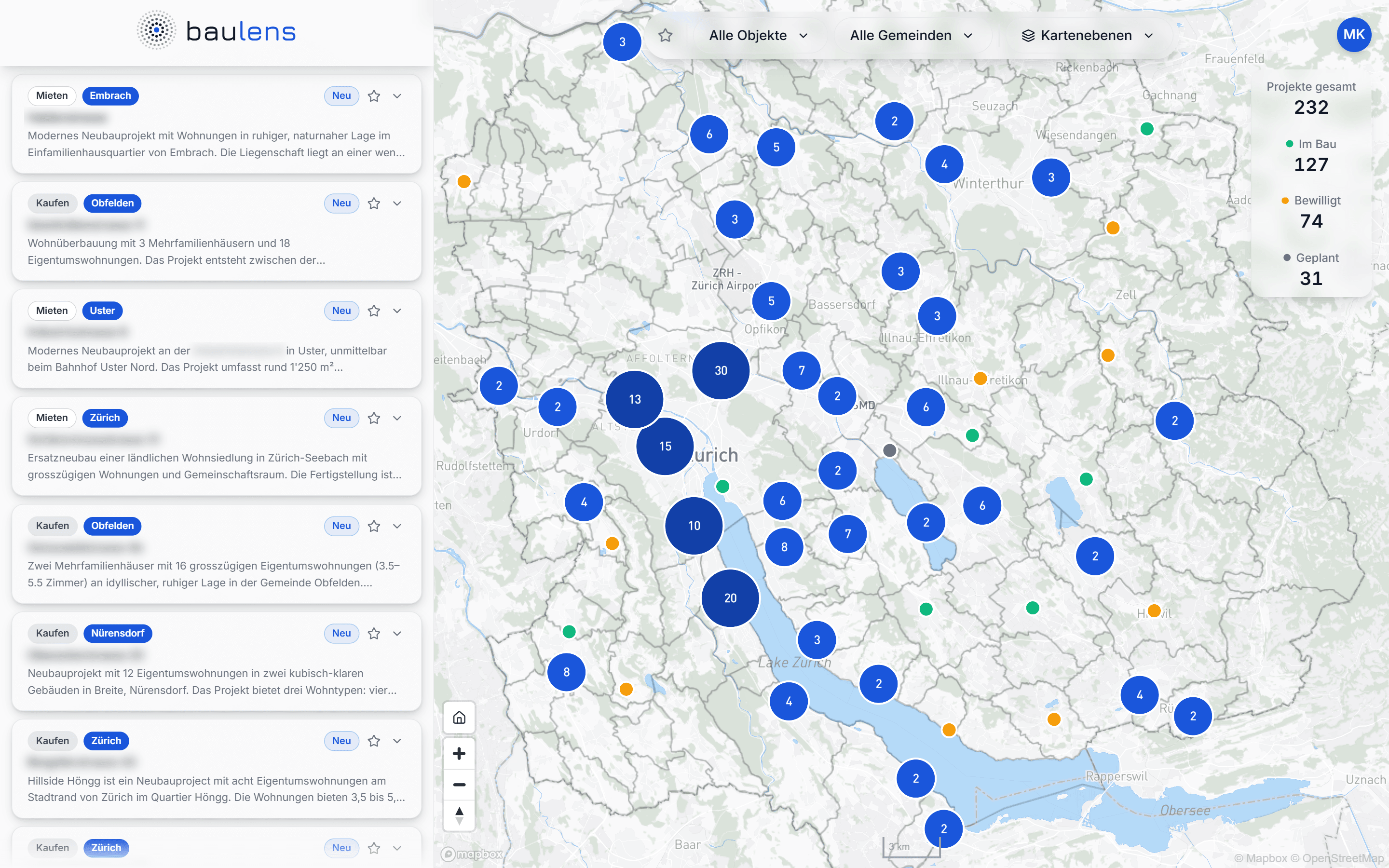
On the Baulens map you can see which new-build projects in Canton Zurich are planned, approved or under construction, and for every municipality the vacancy rate as a time series.